The short answer
Build the model backwards from deals that closed rather than forwards from marketing activity. Score fit and timing as two separate numbers, because a perfect customer who is not looking and a poor fit who is ready need different responses. Agree the threshold with the people who will act on it, and review the model on a schedule.
The failure mode is always the same
Marketing builds a scoring model. Points for opening an email, points for visiting a page, points for downloading a thing. Leads cross a threshold and route to sales. Sales works a few, finds they are not ready, and within a quarter stops looking at the score.
Nobody announces this. The field stays populated and the reports keep running. The model is simply ignored, which is worse than not having one, because it is still routing work.
The cause is almost always that the model was built forwards, from the activity marketing can see, rather than backwards from the deals that actually closed.
Build it backwards, with sales in the room
Take forty or fifty deals that closed and a similar number that did not. Put them in front of the people who worked them and ask a narrow question: what did you notice about these before you knew they were real?
The answers tend to be unglamorous and specific. A pricing page visit. A second visit within a short window. A particular form. A job title. Somebody from a second person at the same company. Almost never a newsletter open.
That conversation does two things. It produces a model grounded in outcomes, and it makes sales co-authors rather than recipients. People use what they helped build, which is not a psychological trick, it is just that they understand what the number means.
Score fit and timing separately
This is the single change that makes the most difference, and it costs nothing.
Fit is who they are: company size, sector, role, geography, the technology they run. It is stable and it comes from data you can append. Timing is what they are doing right now: pages visited, frequency, recency, which form.
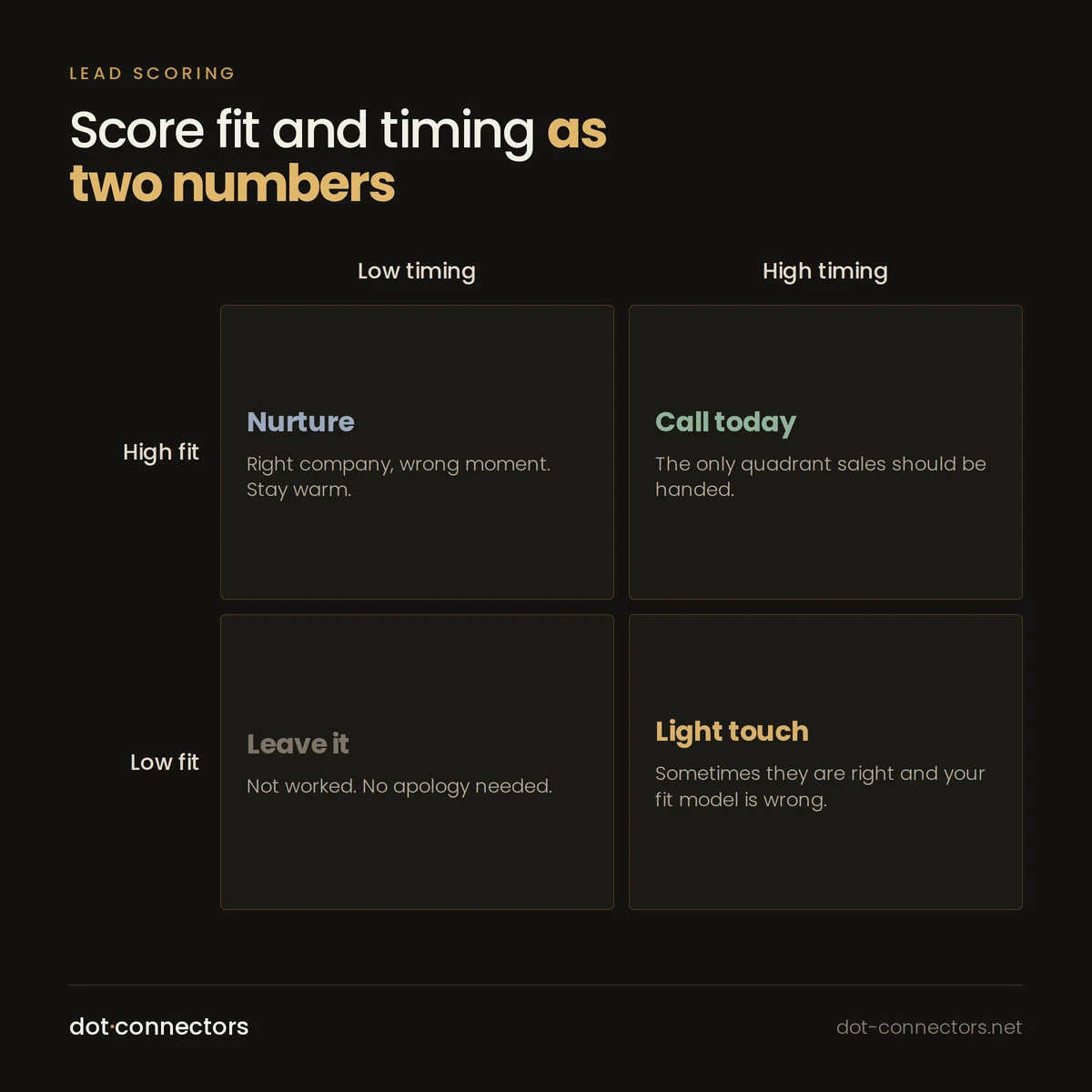
Collapsed into one number, a perfect fit company browsing idly scores the same as a poor fit company requesting a demo, and sales cannot tell the difference. Kept apart, each combination has an obvious action. High fit and high timing goes to sales today. High fit and low timing goes to nurture and stays warm. Low fit and high timing gets a light touch, because sometimes they are right and you are wrong about fit. Low fit and low timing does not get worked.
Two numbers, four behaviours, no argument about what the score means.
Negative scoring, used sparingly
Subtracting points is useful and easy to overdo. Worth deducting for: a personal email domain on a product sold to enterprises, a competitor domain, a careers page visit, a student or job seeker job title, an unsubscribe.
Not worth deducting for: inactivity. Decay is better handled by letting the timing score fall on its own than by punishing people for having a quiet month.
Agree the threshold, then review the model
A threshold set by marketing alone is a guess. Set it with the team that will act on it, and set it against capacity: how many conversations can they actually have this week. A model that produces three times more qualified leads than sales can call is not a success, it is a queue.
Then put a review in the calendar. Quarterly is enough. Behaviour changes, the website changes, the product changes, and a model built once and never revisited is describing a business that no longer exists.
The measure of success is not score accuracy in the abstract. It is whether sales contacts more of the leads you route, and whether more of those become conversations. If both numbers are flat, the model has not earned its place yet.
Where this comes from
We do this work
This article is drawn from how we scope and run campaigns and automation. If you recognised your own setup in any of it, that page covers what an engagement looks like, what is included, and what we will not take on.
Also here
More from insights
- Why your HubSpot and Salesforce records do not match Two systems that can both write the same field will eventually disagree. Here is why, and what to do instead.
- Will server-side tagging recover the data you lost to consent? Short answer: no. Longer answer: it fixes several real problems, and it is worth knowing which.
- GA4 revenue does not match your shop platform The two numbers will never match exactly. The goal is a small gap you can explain in one sentence.
- Duplicate contacts in HubSpot, and how to stop them coming back Every cleanup works. Most of them get repeated two years later, because nobody fixed the thing producing the duplicates.
- Your new website produced fewer leads than the old one It is rarely the design. It is almost always something that was carried across incompletely.
- Zapier, Make or n8n for a marketing team The feature lists are converging. The real difference is operational, and it shows up in the second year.